With employees at aerospace & defense (A&D) manufacturers aging out rapidly, employers need to prioritize attracting and retaining young talent. Being only a few years removed from grad school myself, I see at least three key elements to successfully attract and retain today’s graduates.
These elements are important because having employees who know how to effectively use shop floor technology like Manufacturing Execution Systems (MES) makes good business sense. Such technology makes A&D companies more efficient day to day and ensures knowledge is inherently transferable, which is a crucial point if companies are to keep up with the rapid changeover in their workforces. In short, technology makes you more competitive. Consequently, so does recruiting and retaining folks who know how to use those technologies.
So, on to my three key elements.
1. A heavy dose of technology is a must
First, recognize that students graduating from college today were born in the 2000s, so they’ve likely had some sort of device in their hands from about the time they could walk. They literally grew up with technology. It is intrinsic to their very being. Many would sooner do without a pinky than their phone, pinkies being useless for texting.
In school, they’re learning about technologies like big data and artificial intelligence and using tools to help them do things better and faster. You want these sorts of skills and probably tell prospects as much in the hiring process. So, if on day one you hand them a paper-based binder full of instructions on work processes and procedures, things will not be off to a good start.
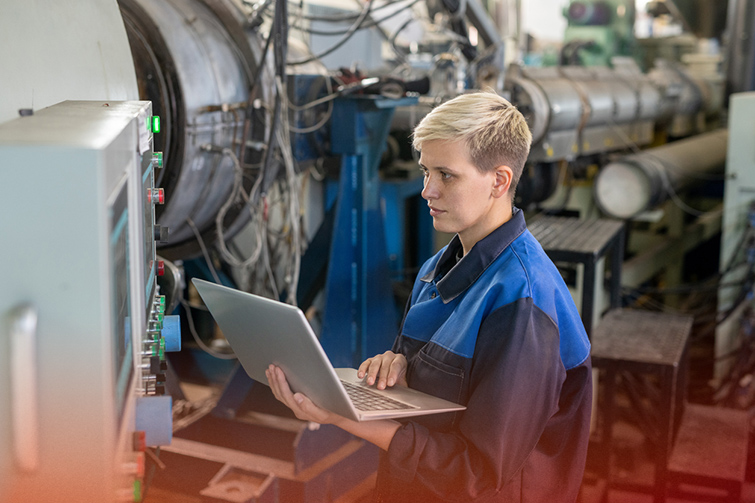
You’re hiring change agents. They expect digital instructions, along with technology like augmented or virtual reality (AR/VR), RFID, and advanced data analytics. Ask them to rebuild a 3D model and force-feed it into a scanned document, and they’ll be spending their lunch break looking for a new gig.

2. Keep up with rapid change
Expectations of new grads are changing rapidly because technology is changing rapidly.
I graduated from Cal Poly not all that long ago and learned about MESs and Enterprise Resource Planning (ERP) tools. So, I understood what they were, how they were used, and so forth. But I didn’t find it all that interesting because it wasn’t tangible at the time. I learned from PowerPoint slides and a professor who, while knowledgeable, hasn’t been on a shop floor since before my parents met each other.
Today, iBase-t provides licenses for our software to select universities, and I’m sure we’re not alone in this endeavor. What’s more, many A&D companies have been encouraging universities to include relevant technology in their curricula because they want new employees to arrive with some understanding of various tools.
That means graduates leave school with hands-on experience using MES, CAD, and data analytics software. As a result, graduates and young professionals have a solid understanding of what such tools can do in the context of their Academic Curriculum. They are also optimistic about how tools like AI are going to push the next generation of technology forward, as they should be.
You want to fuel that optimism, not damper it – because, again, knowledge of such tools is a positive for your organization. If these graduates show up in your environment and don’t find similar tools at their disposal, they may well be disappointed. What’s more, they are likely to quickly forget what they’ve learned about how to use such tools. It’s a disservice to both your organization and to your young talent.
3. Rapid acclimation and knowledge transfer
Once on the job, new college graduates also expect to learn the position differently than even a few years ago.
Gone are the days when tribal knowledge is solely passed down first-hand from more experienced folks to the new hires. Here again, this is a good thing because that was never a very efficient process.
Many new graduates are more comfortable learning with technology involved, such as a system they can touch and interact with, an AV/VR tool, or at least a video. What’s more, since it’s becoming increasingly likely your new hire has some hands-on MES experience from school or a previous employer, their ramp-up time will be much faster if your organization likewise has an MES as opposed to if you’re still relying on paper. That holds true even if you have a different MES from the one your new hire has experience with because previous knowledge is readily transferable; paper-based processes most certainly are not.
The use of technologies such as MES also plays into your ability to retain those new hires. Think about how these new employees have been getting feedback at nearly every level of their educational journey. When they write a paper, it’s typed and submitted online. The teacher likewise provides corrections and feedback online. There’s no paper or handwriting involved at all. They expect, if not rely on, those kinds of efficiencies.
If your organization offers paper and spreadsheets instead of leveraging digital tools, such as Solumina MES from iBase-t, your young talent could soon become frustrated and search for greener e-pastures where they can satisfy their appetites for technology.
Watch this video to see how Solumina MES helps modern manufacturers create a connected, digital-first environment that helps attract and retain today’s tech-savvy workforce and dramatically improves your shop floor efficiency.